Blog — 2 August 2026
A Guide to Facing Check Raises at the Table
This guide to facing check raises shows when to call, fold, or fight back with GTO-calibrated logic, better sizing, and fewer costly mistakes right now.
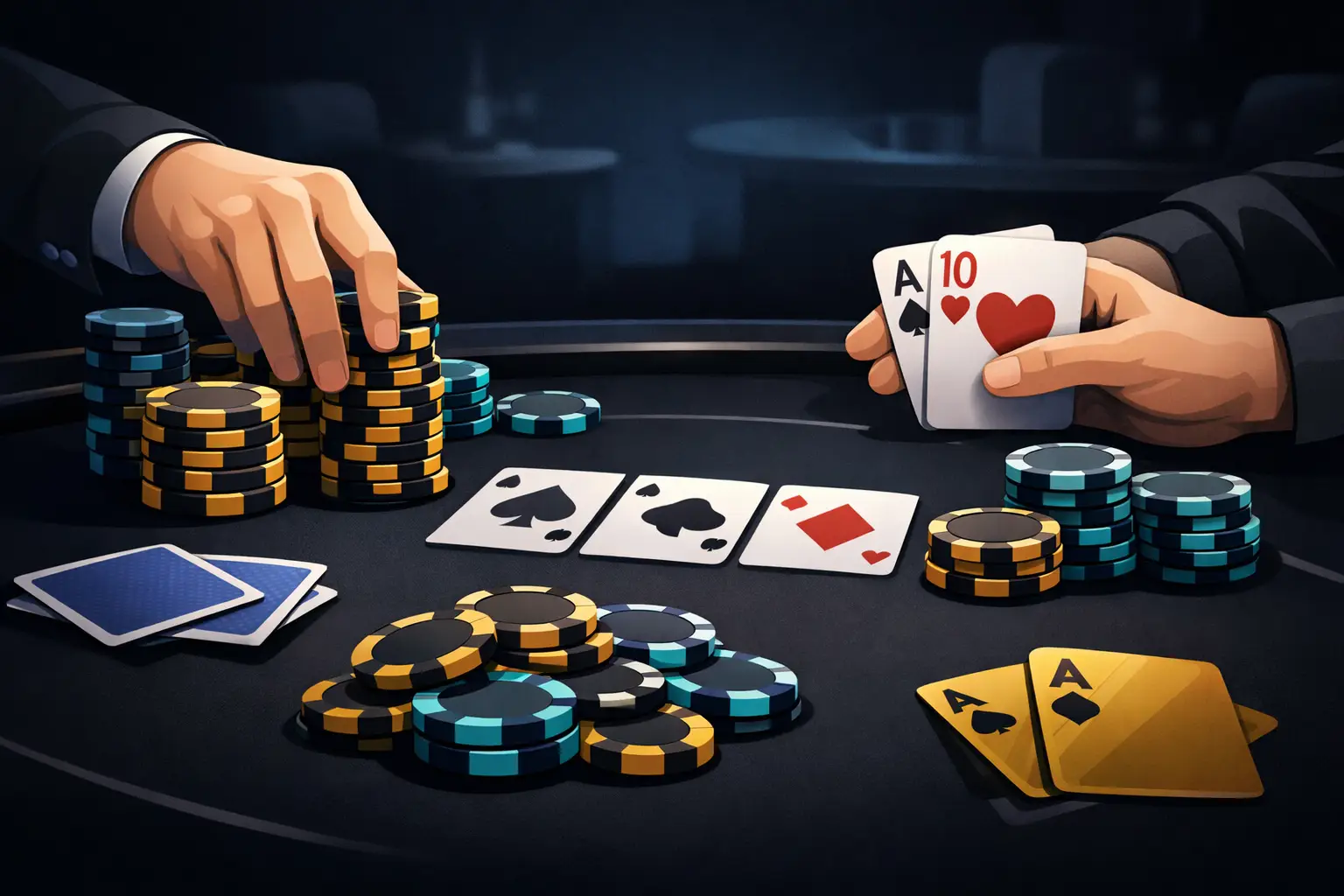
A check-raise is where a lot of players donate chips with a hand they thought was strong. You c-bet top pair, get raised, and suddenly every instinct says the opponent is either bluffing or holding the nuts. Both stories can be wrong. This guide to facing check raises gives you a sharper framework: identify the board, identify your hand class, then choose the line that keeps your range protected instead of your ego involved.
The goal is not to hero-call every aggressive player or fold whenever the pot gets uncomfortable. The goal is to stop making expensive automatic decisions.
Why Check Raises Put You in Tough Spots
A check-raise attacks the player who had the betting lead. When you bet the flop, you usually have range advantage in a raised pot. Your opponent's check-raise challenges that advantage by representing strong made hands, powerful draws, and selected bluffs.
That pressure works because most players c-bet too wide, then continue too loosely once challenged. They see an overpair, top pair, or a gutshot and convince themselves they cannot fold. Before long, they are calling a raise on the flop and another huge bet on the turn with a hand that has almost no clean path to showdown.
Good opponents know this. They use check-raises to force your range into a decision. If you overfold, they print money with bluffs. If you overcall, they print money with value. Your job is to make both routes uncomfortable for them.
Start With the Board, Not Your Hand
The board tells you how often a check-raise should be value-heavy, draw-heavy, or bluff-heavy. Do not evaluate your hand in a vacuum.
On dry, high-card boards like A-7-2 rainbow, the big blind often has fewer natural value combos and fewer credible semi-bluffs than on connected boards. A check-raise can still be strong, but the range is more constrained. This is a better environment to continue with hands such as top pair with a solid kicker, strong backdoor draws, and some ace-high hands that block value.
On boards like J-9-6 with two hearts, the defender has far more two-pair, set, straight-draw, and flush-draw combinations. That does not mean every check-raise is value, but it means you should stop treating one-pair hands like monsters. Your opponent can apply pressure across multiple streets with equity when called.
Paired boards need their own adjustment. On K-8-8, a check-raise from a passive opponent is often heavily weighted toward trips or a full house. Against a capable regular, though, paired boards can be excellent bluffing surfaces because your c-bet range has plenty of unpaired overcards that hate facing heat. Player type changes everything.
Know Which Hands Actually Continue
When facing a raise, sort your hand into one of three buckets: hands that can comfortably continue for value, hands that continue because of equity or blockers, and hands that should fold immediately.
Strong value hands include sets, two pair, strong overpairs on safe textures, and top pair combinations that can withstand future betting. But even these hands are not always automatic stack-offs. Top pair top kicker on a low connected board can be a call, not a re-raise, because jamming isolates you against the hands that beat you while folding out bluffs.
Your next bucket is the money-maker: draws and bluff-catchers with real properties. A nut flush draw, open-ended straight draw, combo draw, or overcards with a premium backdoor draw can call or sometimes re-raise. The exact play depends on stack depth and sizing. You want hands that can improve, block the opponent's strongest value, or remain useful on later streets.
Then come the clean folds. Weak top pair, underpairs, naked overcards with no backdoors, and low-equity draws usually belong here. Folding is not getting pushed around. It is refusing to pay your opponent for telling a convincing story.
Calling Versus Re-Raising the Check Raise
Most players make one of two mistakes: they always call because they want to "keep bluffs in," or they always three-bet because they want to "find out where they are." Neither is strategy.
Calling keeps the opponent's bluffs alive and prevents you from inflating the pot with medium-strength hands. It works best when your hand has showdown value, your opponent can keep bluffing turns, and the board gives you enough strong hands to call with. For example, calling with A-J on J-7-4 rainbow can make sense against a balanced check-raise range. You are ahead of some bluffs, behind some value, and your hand does not need protection from many turn cards.
Re-raising is for polarized hands. Use it with your strongest value hands and your best draws or blocker-based bluffs. On T-8-5 with two spades, a hand like A♠Q♠ has enough equity to apply maximum pressure. If you only re-raise sets, observant opponents will fold every bluff and play perfectly against you.
Sizing matters. A small re-raise gives draws an attractive price and may fail to generate folds. An oversized jam can fold out every worse hand and get called only by the top of the opponent's range. The correct size depends on effective stacks and the texture, but the principle stays the same: choose a size that puts their marginal hands under real stress.
Position Changes the Entire Equation
Facing a check-raise in position is dramatically easier. You see what happens on the turn before committing another bet, which lets you realize equity with hands that would struggle out of position.
In position, you can call more draws and some medium-strength made hands because you control the pot better. You can check back turns that are bad for your range, take free cards, and value bet when the action slows down.
Out of position, you need more discipline. Calling a flop check-raise and then checking the turn puts you under another wave of pressure. Your opponent can barrel favorable cards, check back hands with showdown value, and force you into difficult river decisions. This is why a marginal flop continue can become a turn disaster.
If you are out of position with a hand that cannot call multiple streets, folding the flop is often the highest-EV play. Do not confuse a technically decent-looking hand with a hand that can survive the full betting tree.
Exploit the Player in Front of You
GTO gives you the baseline. Exploits make you money when the pool deviates.
Against a recreational player who rarely check-raises, respect the line. Their range is commonly under-bluffed, especially on later streets. Fold more one-pair hands and do not pay off because you saw one missed draw.
Against an aggressive regular, defend enough that checking and raising you is not free money. Call with suitable bluff-catchers, continue with strong draws, and include some re-raises that punish overaggression. The answer is not to "never fold to a reg." It is to defend with hands that make mathematical sense.
Watch for sizing tells, but do not build your whole strategy around them. Tiny check-raises can be an attempt to set a price with a draw or induce action with a monster. Huge raises can be panic protection, maximum-pressure bluffs, or simply a player who uses one size with everything. Build reads over a meaningful sample.
The Turn Is Where Most Leaks Become Obvious
Your flop decision should come with a turn plan. Before calling a check-raise, ask: which turn cards help me, which cards help them, and what will I do if they bet big?
If the turn completes an obvious draw, your bluff-catcher falls in value. If a blank arrives and they keep firing, consider whether their flop raise contained enough bluffs to justify another call. Many low-stakes players find a flop check-raise but do not have enough turn barrels. That is a major pool tendency you can attack by folding more against sustained aggression.
Conversely, when the turn improves your perceived range more than theirs, be ready to apply pressure. A high card after you defended a check-raise can create opportunities to represent strong top-pair combinations, especially if the opponent's value range is concentrated around middle pairs and draws.
Train the Spot Instead of Guessing
Check-raise spots feel chaotic because players study them too broadly. Fix that by reviewing one recurring configuration at a time: button versus big blind on a low connected flop, cutoff versus big blind on an ace-high board, or single-raised pots at 100 big blinds.
Enter specific hands into a solver, compare your instinct to the recommended action, and focus on the reason behind the answer. Was your hand a call because it blocked value? Was it a fold because it lacked backdoor equity? Was a small c-bet the real mistake that created the spot? PokerMoose can give you immediate GTO-calibrated feedback without turning every review into a three-hour study session.
The fastest improvement comes from building a repeatable habit. After every painful check-raise hand, do not ask whether your opponent was bluffing. Ask whether your hand was supposed to continue against the range they should have. That question turns frustration into a decision you can sharpen before the next session.
Put it into practice — free.
Open the solver, enter the spot you just read about, and see the optimal play instantly.